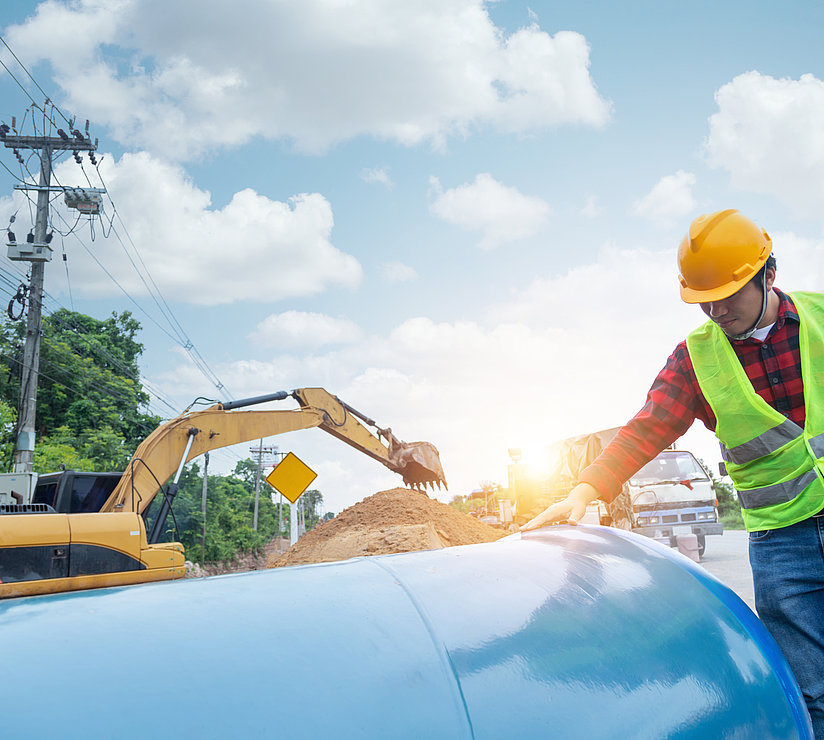
- Material selection between ductile cast iron, PE 100, and PE 100-RC or steel, depending on soil conditions, pressure rating, and installation method
- Pressure zone designs, elevated tanks, pressure-boosting and pressure-reducing systems
- Open-cut construction or trenchless installation in accordance with DVGW GW 321 (controlled flush drilling method), GW 322-1 (pressing and pulling methods), and GW 323 (burst lining)
- Service lines, transfer points, and metering equipment
- Binding cost and schedule estimates as the basis for your investment planning
- Virtually no utility can replace its network all at once. We help direct scarce resources to where they will have the greatest impact:
- Condition assessment based on network and damage statistics in accordance with DVGW W 402
- Water balance, specific actual water loss, and ILI index according to DVGW W 392
- Rehabilitation strategy and prioritization of measures according to DVGW W 403
- Assessment of whether repair, rehabilitation, or replacement is the appropriate solution in each individual case
- Analysis of inventory data to identify remaining lead pipes for which the replacement deadline under Section 17 of the Drinking Water Ordinance (TrinkwV) expired in January 2026
Our network planning takes the following into account:
- The 2023 Drinking Water Regulation, which requires a hazard analysis and risk management throughout the entire supply chain
- New monitoring parameters, including the total PFAS value, which has been in effect since January 12, 2026
- The Water Resources Act, state water laws, and regulations governing water protection areas
- Funding opportunities for network renewal and digitization, including assistance with applications


When do we need a calibrated grid model?
As soon as decisions involving larger investment amounts are at stake. A rough estimate is often sufficient for evaluating a single pipeline replacement project. For pressure zone retrofits, tank sizing, firewater verification, or connecting a new development area, you need a model calibrated using measured data from your network.
What data do we need to provide for a pipeline network calculation?
Ideally, the GIS dataset should include material, nominal diameter, year of construction, and elevation, as well as annual consumption data, daily flow profiles, and available pressure measurements. Missing data is not a criterion for exclusion. We regularly work with incomplete historical datasets and fill in the critical gaps through follow-up surveys and temporary measurement campaigns.
Are you also planning the fire water supply?
Yes. The firewater verification in accordance with DVGW W 405 is an integral part of our network calculation. Where the network cannot meet the fire department’s needs, we identify alternatives, such as firewater tanks or independent firewater supply points.
What are the benefits of a water balance analysis according to DVGW W 392?
It highlights where water is lost and how your network compares. The ILI puts actual water loss into perspective relative to network length, connection density, and operating pressure. Only this metric allows for comparisons of network condition over the years and across utilities.
Network Planning That Keeps Things Running
Whether it’s a new construction project, a network upgrade, or the integration of a new service area: We provide you with network planning that includes calculated verifications, a forward-thinking approach to hygiene, and an action plan that fits your budget.
Do you have any questions? We’re happy to answer any inquiries you may have regarding network planning, pipeline network calculations, and drinking water networks.
