
Our Services in Indoor Cabling
Our experienced team of construction managers and sales representatives will guide your NE-4 project through every phase:
- Design of NE-4 In-Building Cabling for Multi-Family Dwellings
- Design and project implementation for commercial and special-needs customers
- Process-oriented consulting tailored to your rollout specifications
- Communication and coordination with property owners, management, and tenants
- Planning the route from the building service entry point (HÜP) to the floor distribution point
- Use of risers, empty conduits, or stairwells depending on the building’s structure
- Central placement of the fiber-optic subscriber connection (GF-TA)
- Consideration of structural conditions in new construction, older buildings, and existing structures
- Standard-compliant conduit with an inner diameter of at least 10 mm, a smooth inner surface, and a sufficient bend radius
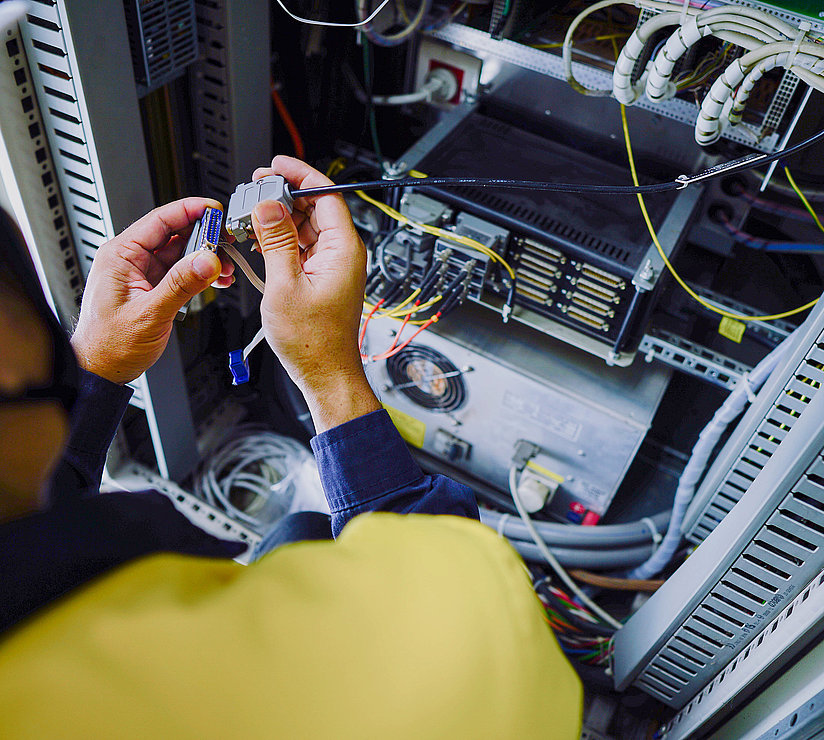
- Damage-free installation of fiber-optic cables all the way to the end device
- Installation of patch cables to the router, with proper strain relief
- Optical cleaning of the fibers prior to termination
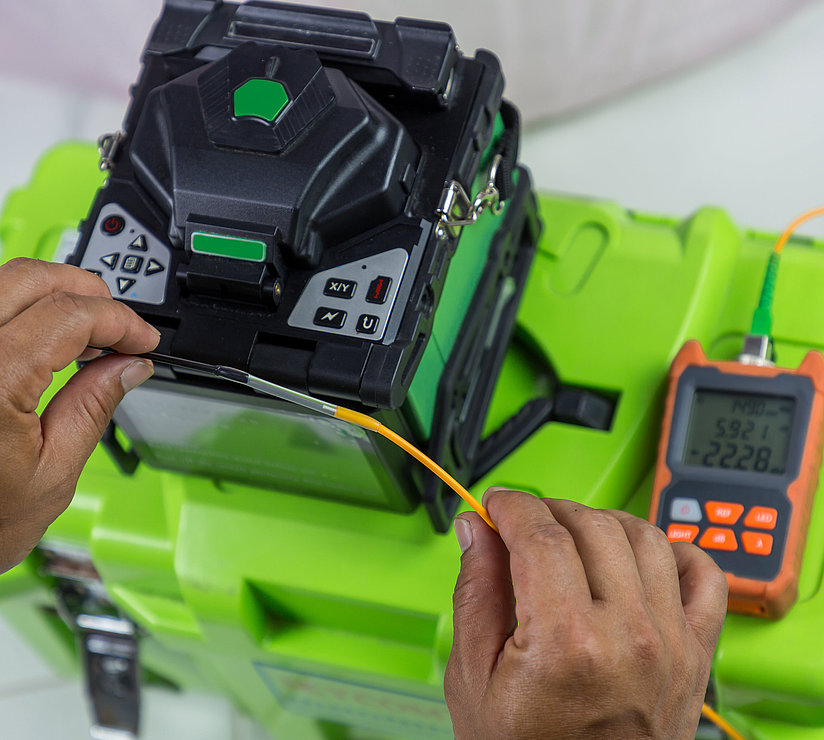
- Measurement of attenuation and reflection using certified test equipment
- Testing of connection quality along the entire route
- Test reports as proof of functionality and quality
- Handover and commissioning of the subscriber line
- Coordination of construction work and the various trades involved
- On-site supervision of installation work
- Review of measurements and invoices
- Supervision of defect rectification until final acceptance

Our Services in Indoor Cabling
Our experienced team of construction managers and sales representatives will guide your NE-4 project through every phase:
What does "NE 4" mean in the context of fiber optics?
NE 4 stands for Network Level 4, the final segment of the fiber-optic network within a building. It begins at the building transfer point and ends at the fiber-optic subscriber connection box in the apartment. The preceding network levels cover the long-distance network, regional distribution, and the local network up to the building. Without a properly implemented NE 4, the connection remains faster on paper than it is at the outlet.
Who is responsible for the internal wiring in an apartment building?
That depends on the deployment model and the agreement with the property owner. In practice, the network operator handles the cabling as part of the rollout; coordinating with the property owner and management is the critical step. This coordination is precisely what’s included in our scope of services, to ensure that the construction doesn’t run into trouble due to permitting issues.
Which conduit and fibers are suitable for FTTH within a building?
For cable routing within the building, conduit with an inner diameter of at least 10 mm, a smooth inner surface, and a sufficient bend radius is recommended. For the fiber, we rely on bend-resistant types compliant with ITU-T G.657, which can be installed even with tight bends in stairwells and within apartments, and are compatible with the widely used G.652 standard.
How is the quality of the cabling verified?
Through measurements conducted with certified equipment. We test attenuation and reflection along the entire route and provide a measurement report. This documentation serves as the basis for acceptance and is often a prerequisite for the release of funds in subsidized projects.
Do you also install flooring in older buildings and historic structures?
Yes. The existing infrastructure is precisely the most challenging part of NE 4. Where there are no empty conduits and historic preservation regulations come into play, we plan the route of the lines on a case-by-case basis and coordinate the visible elements with the property owner and the authorities.
Do you need an NE-4 team for your nationwide rollout?
Whether it’s a single apartment building or an entire development: Our team plans, coordinates, and oversees your in-building cabling through to the documented acceptance. Talk to us about your project.
Do you have any questions? We’d be happy to answer any questions you may have regarding in-building cabling, Layer 4, and FTTH building cabling.
